
#AI4M: Who Controls the Cart? AI Shopping Agents and the Battle for the Customer Relationship
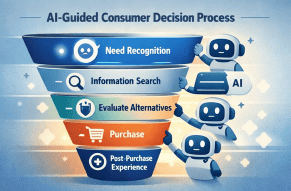
Two recent Wall Street Journal articles offer marketing instructors a timely window into one of the most significant shifts in consumer behavior and retail strategy in years: the rise of AI-powered shopping agents. Together, they make a compelling case for discussing how technology is reshaping the consumer decision process — and why that matters for retailers trying to protect their customer relationships.
The first article, “Google Bets on AI-Based Shopping With New AI Agents for Retailers” (Wall Street Journal, January 11, 2026), reports that Google has unveiled a suite of tools designed to help retailers deploy their own AI-powered shopping assistants, branded under its Gemini Enterprise for Customer Experience platform. Major chains including Lowe’s, Kroger, and Papa Johns are already testing these tools. Kroger’s mobile app-based agent, for example, can understand a shopper’s time constraints, meal plans, price sensitivity, and brand preferences to personalize the experience end-to-end. Lowe’s reports that its AI assistant, Mylow, more than doubles the company’s conversion rate when customers engage with it online. The strategic insight buried in these examples is important: retailers who build their own AI channels retain far more control over how their products are presented — and sold — than those who rely on third-party platforms.
That control question is exactly what the second article wrestles with. “ChatGPT Should Make Retailers Nervous” (Wall Street Journal, October 21, 2025) argues that while retailers like Walmart, Etsy, and Shopify have eagerly partnered with OpenAI’s Instant Checkout feature to gain first-mover advantage, the longer-term risks are real. When consumers shop entirely within a chatbot — asking for recommendations, comparing options, and completing purchases without ever visiting a retailer’s website — retailers lose the customer touchpoints that drive loyalty, add-on sales, and advertising revenue. More than 60% of the estimated $59 billion that companies spend annually on U.S. retail advertising is tied to search placements on retailers’ own sites and apps. If AI chatbots become the primary point of product discovery, those ad dollars could follow consumers elsewhere. Amazon has taken a notably different approach, blocking AI chatbots from scraping its listings while quietly building its own AI shopping features in-house.
The tension between these two articles is what makes them so useful for class. Retailers face a classic strategic dilemma: gain rapid distribution by partnering with dominant AI platforms, or invest in building proprietary AI channels to protect long-term customer relationships and revenue. There is no tidy answer here — and that ambiguity creates exactly the kind of productive classroom conversation that helps students develop genuine marketing judgment.
Relevant Chapters in Essentials of Marketing
These articles connect most directly to Chapter 5 (the Consumer Decision Process, psychological influences on buying behavior, and economic needs), as AI agents fundamentally alter how consumers search for information, evaluate alternatives, and make purchase decisions — compressing or bypassing steps in the traditional decision process entirely. They also connect to Chapter 3 (the Technological Environment and Competitive Environment), as the race among Google, OpenAI, and Microsoft to dominate AI-assisted commerce is a textbook example of how rapid technological change forces companies to reassess their strategies in real time. Chapter 10 (Place and Development of Channel Systems, including multichannel distribution and channel relationships) is directly implicated as retailers weigh building proprietary AI channels against ceding distribution to third-party platforms — a decision with significant consequences for channel power and customer ownership. Finally, Chapter 12 (Retailing and the Internet, Why Retailers Evolve) offers a useful lens for examining how AI is driving the next wave of retail evolution, and which retailers are best positioned to adapt.
Class Discussion Ideas
These two articles work well together as a paired reading. Consider asking students to come to class prepared with one retailer they think is well-positioned for AI-assisted shopping — and one that isn’t — and why. The activities and questions below are designed to push students beyond surface-level observations toward the strategic trade-offs at stake.
In-Class Activities
- The AI Decision Audit. Have students map out the traditional five-step consumer decision process (problem recognition, information search, evaluation of alternatives, purchase decision, post-purchase evaluation) and then rebuild it as it would look when an AI agent handles the shopping on a consumer’s behalf. Where does the process compress? Where does the human consumer still remain in control? What are the implications for marketers who have traditionally intervened at specific steps? Groups can present their maps and compare findings in a class discussion. (Chapter 5)
- Retail Channel Strategy Showdown. Divide the class into two teams: one argues that retailers should partner with universal AI platforms (ChatGPT, Google Gemini) for maximum reach and first-mover advantage; the other argues that building proprietary AI agents is the only way to protect long-term customer relationships and advertising revenue. After the debate, discuss as a class what criteria should guide that strategic choice for different types of retailers. (Chapters 10 and 12)
- Customer Data and AI: Who Benefits? Ask students to consider: when Kroger’s AI agent learns a customer’s price sensitivity, brand affinity, and meal planning habits, who owns that data and who benefits from it? Compare this to Amazon’s decision to block third-party AI scrapers. What does this suggest about the strategic value of first-party customer data, and how should brands think about giving that data to platform intermediaries? (Chapters 5 and 7)
Discussion Questions (with Suggested Answers)
- How does the emergence of AI shopping agents alter the consumer decision process described in your textbook? (Chapter 5)
- Answer: The traditional consumer decision process involves five steps: problem recognition, information search, evaluation of alternatives, purchase decision, and post-purchase evaluation. AI agents have the potential to compress or automate the middle three steps entirely — doing the searching, comparing, and even purchasing on behalf of the consumer. This raises important questions about where marketers can still influence buyer behavior, since traditional touchpoints like a retailer’s website or search results may no longer be part of the shopper’s journey. Marketers may need to think about how to communicate brand value to an AI agent, not just directly to the consumer. The implication is significant: brand awareness and preference must now be established early enough that they become inputs into an AI’s decision criteria.
- The Wall Street Journal article on ChatGPT notes that retailers risk losing add-on sales and advertising revenue if shoppers bypass their websites. How does this connect to what marketers think of as “place” in the marketing mix? (Chapter 10)
- Answer: Place is about more than physical location — it encompasses how and where customers access a product and how channel relationships are managed. Retailers’ websites and apps have become prime “places” where product discovery, comparison, and purchase all happen, and where retailers earn significant advertising revenue from brands paying for prominent search placement. If AI agents move the point of discovery elsewhere, retailers lose control of this critical channel. This illustrates that place decisions are never just about logistics — they are about managing customer relationships and revenue streams. The balance of power in channel systems can shift rapidly when new intermediaries (like AI chatbots) emerge, as the article’s analogy to third-party airline booking sites makes clear.
- Amazon’s decision to block AI chatbots from scraping its listings is quite different from Walmart’s decision to partner with ChatGPT. Which approach do you think represents the stronger long-term strategy, and why? (Chapters 3 and 10)
- Answer: Both strategies reflect legitimate responses to a genuinely uncertain environment, and students should be encouraged to resist the temptation of a single right answer. Walmart’s partnership approach prioritizes reach and first-mover advantage, betting that being present wherever consumers shop is worth the trade-offs in customer data and loyalty. Amazon’s approach prioritizes control over its customer data and advertising ecosystem — sensible given that advertising has become a major profit driver for its e-commerce business. The best strategy likely depends on a company’s existing competitive advantages, how heavily its revenue relies on advertising and first-party data, and how quickly AI-based shopping adoption accelerates in its product categories. This question pairs well with Chapter 3’s discussion of screening criteria for evaluating opportunities in changing environments.
- Kroger’s chief digital officer suggests that retailers not already deeply invested in AI agents are creating a competitive disadvantage for themselves. How does this reflect the concept of the technological environment discussed in your textbook? (Chapter 3)
- Answer: Chapter 3 describes the technological environment as a source of both opportunity and competitive threat. Kroger’s comment captures exactly this dynamic: companies that move early to adopt enabling technologies can build capabilities that competitors cannot replicate quickly. The pace of change in AI — described in the Google article as moving so fast that technology can become outdated in two weeks — makes this a particularly high-stakes environment. For students, it reinforces a broader lesson: monitoring the technological environment must be a continuous discipline, not a periodic exercise, because windows of competitive advantage can open and close very quickly. Lowe’s experience, where it hedges by working with multiple AI vendors simultaneously, is a good example of managing technological risk in a fast-moving environment.
- How might AI shopping agents affect brand loyalty, and what does this mean for companies that have invested heavily in loyalty programs? (Chapter 5)
- Answer: AI agents that prioritize efficiency and objective product attributes may route consumers toward the “best” functional option rather than a preferred brand — potentially undermining the habit-based and psychologically driven loyalty that marketers work hard to build. If a shopper delegates grocery purchasing to an AI agent that automatically selects the lowest-cost option meeting a set of criteria, years of brand investment may be bypassed in a single session. Companies with robust loyalty programs backed by rich customer data — like Kroger — may be better insulated, because that data can be fed back into the AI agent to reinforce preferences. This raises a useful discussion point: what does brand loyalty even mean in a world where an algorithm, not a human habit, may increasingly drive the purchase decision?
- The Wall Street Journal analysis compares AI shopping agents to third-party airline booking sites like Expedia, which airlines have had to navigate carefully to avoid ceding control of add-on sales. What does this analogy suggest about how retailers might manage their relationships with AI platforms going forward? (Chapters 10 and 12)
- Answer: The airline analogy is instructive because it shows how a channel relationship that initially seems beneficial — more distribution, more visibility — can erode a company’s pricing power and ability to upsell over time. Airlines responded by pulling fare information from some third-party sites and investing heavily in direct-booking capabilities. Retailers may face similar pressure if AI chatbots become dominant shopping interfaces: at some point, the cost of lost ad revenue and customer data may outweigh the benefit of channel reach. This suggests retailers should treat AI platform partnerships as a short-to-medium-term tactic while simultaneously building proprietary capabilities that keep customers within their own ecosystems — a balance that Kroger and Lowe’s appear to be attempting by working with multiple vendors, including developing their own tools.
- Thinking broadly, does the rise of AI shopping agents represent a threat, an opportunity, or both for marketing as a discipline? (Chapter 19)
- Answer: This question invites students to reflect on the macro-level implications of a specific trend — a useful exercise for Chapter 19’s broader appraisal of marketing’s future role in society. AI shopping agents simultaneously threaten traditional marketing tools (advertising placements, brand loyalty programs, owned media) and create new opportunities to serve customers with unprecedented personalization and efficiency. At a macro level, AI could benefit consumers by reducing information asymmetry and making it easier to find genuine value. At a micro level, it forces marketers to think more creatively about building brand differentiation in a world where algorithms may increasingly drive purchase decisions. Encourage students to take a position and defend it — the diversity of answers in the classroom tends to be valuable here.
The chatbot Claude generated a first draft of this blog post. The images were generated by ChatGPT.