
#AI4M: The Bots Are Coming to Shop. Will Retailers Let Them In?
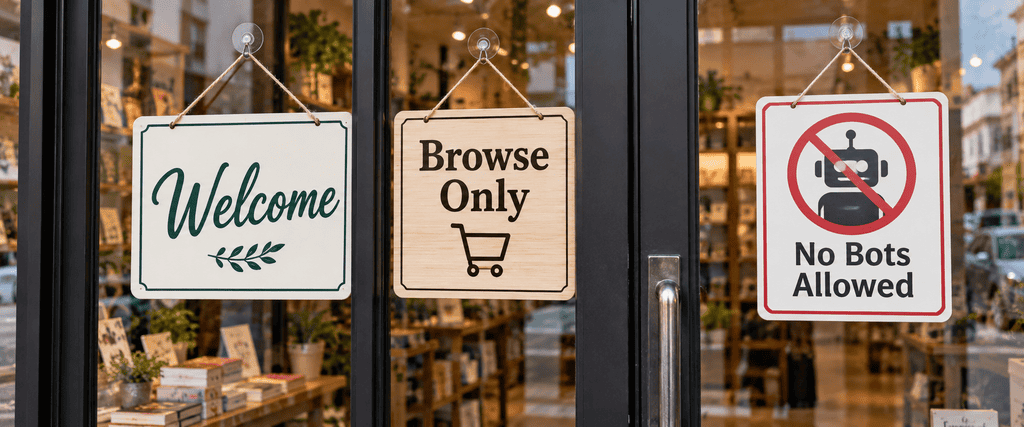
AI shopping agents have moved from tech-conference talk to real business decisions. In just a few weeks, three stories that, read together, show the whole system taking shape: the payment networks building the rails, the retailers deciding whether to open their doors, and the courts trying to figure out who is actually doing the shopping. Our students are the consumers these agents are being built for, which makes this a great topic for class discussion.
Articles Summary
In Mastercard Joins Visa in Letting AI Bots Do Your Shopping, the WSJ reports that Mastercard has partnered with the startup Alchemy to let consumers issue a virtual credit card to their own AI agent. The cardholder sets the limits, such as a spending cap or a list of approved retailers, and the agent can then buy anywhere Mastercard is accepted online, without checking back first (though users can require that). Visa signed on with Alchemy earlier in the year, so most credit cards now work with the tool. Payments executives say agentic commerce is a matter of “when,” not “if,” but they admit trust is the biggest obstacle. Consumers worry about a rogue agent going on a shopping spree, and nobody knows yet who is liable for a purchase the cardholder never really intended.
In March, the WSJ article Amazon’s Win Against Perplexity Kicks AI Shopping Wars Into High Gear reported that a federal judge had barred Perplexity’s Comet browser agent from shopping in password-protected parts of Amazon’s site. That win didn’t last. In August, the Ninth Circuit vacated the injunction, holding that Amazon’s own customers, not Perplexity, were the ones accessing the site through Comet. The court stressed that it was not creating a new legal framework for agentic AI, and the case continues in district court. For marketers, the bigger story is the economics. AI bots skip ads and sponsored search results, and Amazon earned $68 billion from advertising last year. Walmart and Target are taking a different approach, putting their own assistants and retail media ads inside ChatGPT and Gemini.
The third article, AI Agents Aim to Change Shopping. Some Retailers Are Locking the Doors. looks at how retailers are responding to Meta’s new Muse agent, which can shop on its own. The responses range widely. QVC and HSN welcome agents and even send their catalogs to OpenAI and Google. Gap decides case by case which agents can browse and which can buy. Tapestry (Coach and Kate Spade) lets agents browse but not check out, citing fraud and bots hoarding inventory, though it is quietly building checkout capability just in case. Amazon blocks agents from Meta, OpenAI, Google, Anthropic, and Perplexity, and eBay requires express permission. Meanwhile, consumer demand is unproven: only 3% of U.S. adults say they would trust an agent to complete a purchase. As one analyst put it, tech circles may be wrong in assuming that people don’t like shopping.
Claude was used to develop a first draft of this blog post.
Relevant Chapters in Essentials of Marketing
These three articles fit together nicely. You could assign them as a set or each one also works on its own.
- Chapter 12 (Trends in Online Commerce, Exhibit 12-7; AI-powered shopping assistants and chatbots; conversational commerce; omnichannel and unified commerce; the “Psychic retailers” box) is an obvious connection. The chapter describes retailer chatbots as reactive tools that live on the retailer’s own site. Muse and Comet go a step further: these agents come from outside and act independently, which is exactly why retailers like Amazon want to keep shoppers inside their own channels.
- Chapter 5 (The Consumer Decision Process; AI, predictive analytics, and the consumer decision process; the adoption process; AI nudging and its ethical questions) covers the consumer side. An agent that searches, compares, and buys is taking over steps students already know, and the adoption process helps explain why so few consumers trust agents to complete a purchase.
- Chapter 3 (The Legal Environment; the legal environment for marketing and AI; the technological environment, including intelligent agents; the competitive environment) fits the Amazon v. Perplexity case, the open liability questions in the Mastercard article, and the competitive logic that leads Walmart and Target to embrace AI platforms Amazon is blocking.
Class Discussion Ideas
These articles invite students to see agentic commerce from three positions: the payment networks building the rails, the retailers deciding whether to open their doors, and the consumers who must decide whether to hand over their credit card. The activities below ask students to take on those roles. The discussion questions move from understanding how the technology works to evaluating whether retailers are making smart bets.
In-Class Activity Options
- Open, Gated, or Locked? Assign each small group one retailer from the articles: QVC, Gap, Tapestry (Coach and Kate Spade), Amazon, eBay, or Walmart. Each group describes where its retailer sits on the spectrum from “welcome agents” to “block them entirely” and explains why that position fits the retailer’s target market, product line, and business model. Groups then recommend whether to stay put or move. This works well as short presentations, with the class arranging the retailers along a line on the whiteboard as each group reports. (Chapters 12 and 3)
- Program Your Agent. Using the Mastercard/Alchemy model, students write the permission rules they would give an AI agent for three purchases (see Exhibit 5-11): routinized response (laundry detergent), limited problem solving (running shoes), and extensive problem solving (a laptop or a spring break trip). For each, they decide the spending cap, approved retailers, and whether the agent must check back before buying. The debrief should show that students give agents much more freedom for routine purchases than for extensive problem solving. Students can work individually and then compare with a partner. (Chapter 5)
- Who Is Really Shopping? Stage a short debate around the Amazon v. Perplexity case. Perplexity argued that a Comet user reaching Amazon is no different from a Safari user, which no one would call Apple accessing Amazon. Amazon countered that Perplexity’s servers direct the agent, so users are merely go-betweens, comparing it to an arsonist blaming the mail carrier who delivered the bomb. Half the class argues each side, then everyone discusses whether the answer should change if the agent buys without asking the user first. (Chapter 3)
- Follow the Ad Dollars. Ask students to trace what happens to a brand’s sponsored product ad on Amazon when an AI agent, not a person, does the shopping. Then have them draft a one-page memo to a consumer packaged goods brand manager on how to stay visible when bots make the choice. This works as a homework assignment that feeds a class discussion. (Chapter 12)
- Would You Hand Over the Card? Run a quick anonymous poll: Would you let an AI agent complete a purchase for you without checking with you first? Compare the class results to the survey in the WSJ article, where only 3% of U.S. adults said they would trust an agent to complete purchases. Then ask students where they sit in the adoption process and what would move them to the next step. (Chapter 5)
Discussion Questions and Instructor Notes
- How does the Mastercard/Alchemy system work, and what controls does a cardholder keep? Why would payment companies want to build this before consumer demand is proven? (Chapter 3)
- Answer: The cardholder issues a virtual card to their AI agent and sets limits, such as a spending cap, approved retailers, or a requirement to check back before buying. “Agentic tokens” carry both the payment data and a record of the user’s intent. Payment networks are responding to changes in the technological environment, and they want to set the standards rather than react to someone else’s. Students may note that Visa, Mastercard, and American Express are all moving at once, which shows the competitive pressure to avoid being left out.
- Using the steps in the consumer decision process (see Exhibit 5-9), which steps would an AI shopping agent take over? Which steps would consumers most likely want to keep for themselves? (Chapter 5)
- Answer: Agents fit naturally into information search, evaluating alternatives, and the purchase itself, and they can watch for price drops in ways people rarely bother to. Need recognition may stay with the consumer, though predictive tools like smart refrigerators are already moving into that step. Many students will want to keep the final decision for products that express their identity or involve a lot of money. Post-purchase evaluation is interesting to discuss, since a consumer can’t feel regret over a choice they barely made.
- Why does Amazon fight to keep outside AI agents off its site while Walmart and Target partner with AI platforms? (Chapter 12)
- Answer: Amazon has the most to lose. It earned $68 billion from advertising last year, and that business depends on shoppers seeing sponsored results on Amazon’s own pages. Agents skip those ads and take away Amazon’s customer data and direct relationship. Walmart and Target are challengers, and AI platforms give them a chance to reach shoppers who would otherwise go straight to Amazon. Students should see that the same technology looks like a threat or an opportunity depending on a firm’s competitive position.
- Only 3% of U.S. adults say they would trust an AI agent to complete a purchase. Where are most consumers in the adoption process, and what would move them forward? (Chapter 5)
- Answer: Most consumers are at awareness or interest; few have reached trial. Trial is a major barrier because the perceived risk is high: a rogue agent spending your money feels very different from a free app trial. Spending caps, one-time card numbers, and check-before-buying options lower that risk and make trial easier. Students might suggest starting with low-risk routine reorders, so consumers build confidence before giving agents more freedom.
- eBay believes AI can’t make the judgments needed to shop for handmade and preowned goods. For what kinds of products do AI agents make the most sense, and for which do they make the least? (Chapter 5)
- Answer: Agents fit best where products are standardized and purchases are routine, such as household staples or a specific model number where price and delivery are the main differences. They struggle where quality varies item by item, where style and taste matter, or where the shopping itself is part of the enjoyment. Students can connect this to routine versus extensive problem solving. The analyst’s point that people actually like going to the grocery store is a useful challenge to the assumption that everyone wants shopping automated.
- Tapestry lets AI agents browse Coach and Kate Spade but not buy, while building checkout capability just in case. Is this a smart hedge or a missed opportunity? (Chapter 12)
- Answer: Many students will see it as a smart hedge. It gives Tapestry visibility in AI search while protecting against fraud and bots hoarding inventory in shopping carts. Building checkout capability now is what one consultant calls a “no-regret investment.” On the other hand, if agents become a meaningful channel, competitors that let agents check out may capture those sales first. The best answers recognize that a luxury brand also has reasons to protect the in-store and on-site experience that supports its premium image.
- When an AI agent shops for you, whose interests does it serve: yours, the retailer’s, or the company that built the agent? Take a position. (Chapters 5 and 12)
- Answer: There is no single correct answer, and that is the point. An agent built by Walmart (Sparky) will naturally favor Walmart products, while an independent agent like Muse or Comet may be more neutral, though its maker has its own business interests. Chapter 5’s discussion of AI nudging asks when a helpful suggestion becomes manipulation, and that question becomes sharper when the agent makes the purchase itself. Strong answers will consider transparency: should consumers know who built the agent and how it ranks options?