
The Transformation Economy
Over 25 years ago, B. Joseph Pine II and James Gilmore made business leaders think differently with their book The Experience Economy. The insights from that book changed how many of us think about Product, as more than a good or service, but also a total customer experience. At the time, Pine talked about a progression of economic value from extracting commodities to making goods, to delivering services, to staging experiences. As firms move up the ladder, they avoid the commoditization of their businesses and earn higher profits. Pine warns that if you don’t move up the ladder, you will eventually be commoditized. Each new source of economic value assures that you aren’t racing to the bottom (becoming the cheapest).
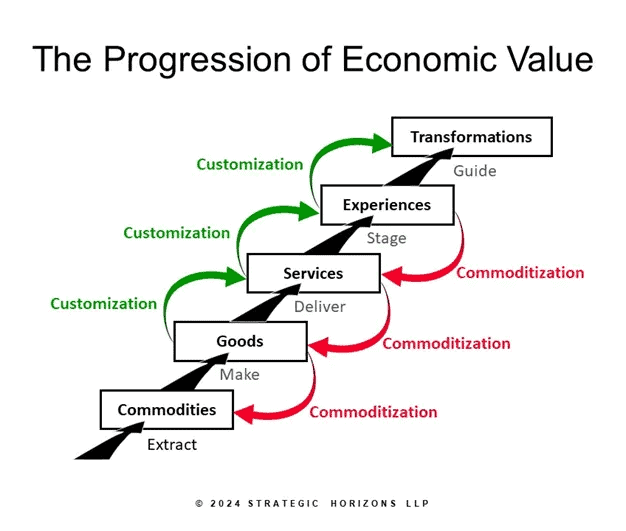
In his latest book, The Transformation Economy: Guiding Customers to Achieve Their Aspirations, Pine describes the next level of economic value that businesses can create: transformational experiences. Customers move from experience (“I enjoyed that”) to transformation (“I am different because of that.”). Businesses have a new way to deliver value as their role becomes guides that help customer achieve personal or professional goals.
Pine has been developing these ideas publicly via Substack for a couple of years, and two posts in particular are worth bookmarking for your course: one on “Levels of Experience” and another on “The Four Realms of Experience.” For a deeper dive, a 43-minute podcast interview is available if you want to invest more time. The shorter book teaser below is a good starting point–it covers Pine’s core argument in juist a few minutes and could be shown at the start of a Product class session.
I have not yet read the book (though it is on my wish list), so I asked Gemini AI for some examples. Gemini offered four examples that span industries. Noom applies cognitive behavioral therapy and AI coaching to shift a user’s relationship with food — not just help them lose weight, but change how they think about eating permanently. London Business School frames its MBA not as a credential but as a professional identity shift from manager to global leader. Johnnie Walker’s “Princes Street” experience in Edinburgh takes a liquor brand into personal aspiration territory, linking the product to the consumer’s own life narrative. And Cognizant, in a B2B context, has experimented with outcome-based pricing tied to measurable efficiency gains — charging for transformation, not hours.
In-Class Activity Ideas
I like that this concept builds on ideas already in your students’ reading (differentiation, sustainable competitive advantage, consumer behavior, Product – experience, and Price). Consider adding one of the following to class sessions on these topics:
- Map a Brand Up the Ladder Provide students with a list of five to eight companies drawn from different industries (a coffee shop, a gym, a university, a software company, a consumer packaged goods brand). In small groups, students place each company on Pine’s value progression — commodity, good, service, experience, transformation — and defend their placement. Then ask: What would it take for each company to move up one level? Groups present their most interesting case to the class. This works well as a lead-in to discussing “What Is a Product?” in Chapter 8 and the product life cycle in Chapter 9.
- The Transformation Pitch Each student (or pair) selects a brand they use personally — gym, app, food service, school, etc. — and prepares a two-minute pitch reframing that brand’s value proposition as a transformation offer rather than a service or experience. The pitch must answer three questions: Who is the customer becoming? What is the “guide” role the company plays? How would you measure whether the transformation happened? After pitches, the class votes on which brand has the most credible transformation claim and discusses why. Connects to Chapter 8 (product strategy), Chapter 5 (consumer motivation and aspirations), and Chapter 2 (positioning).
- Outcome-Based Pricing Workshop The Cognizant B2B example opens an interesting pricing discussion. Present students with a scenario: a marketing consulting firm that currently charges by the hour wants to shift to outcome-based pricing aligned with Pine’s transformation model. In groups, students must define (a) what “transformation” looks like for the client, (b) how they would measure it, and (c) what pricing structure they would propose. Groups share their models and the class debates the risks and benefits. This connects well to Chapter 17 (pricing objectives and policies) and Chapter 18 (price setting), and could also tie to Chapter 6 if you want to bring in the B2B buyer relationship angle.
A couple of AI tools, Claude and Gemini, were used to assist in generating content for this post.