
#AI4M: When the Reader Is a Robot — Time Starts Selling Ads to AI Agents
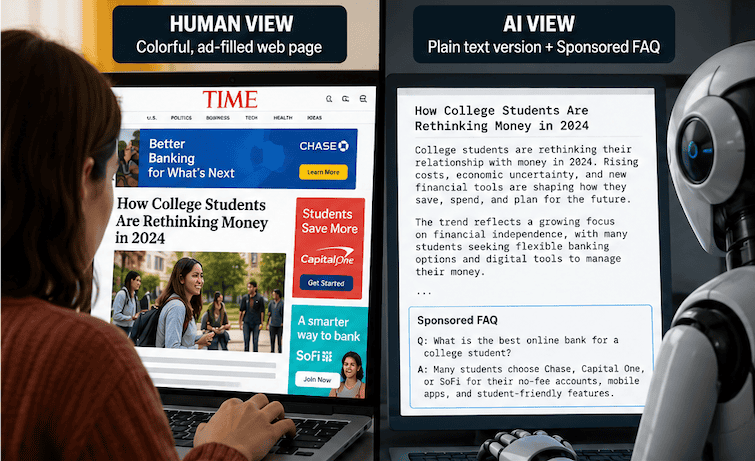
If AI agents end up doing more of our shopping, who is the advertiser really trying to persuade? Time magazine has placed an early bet on the answer: the bot. This makes a great topic for class because nobody knows yet how it will turn out, including the companies doing it. Below I summarize two Digiday articles and a short podcast, then offer textbook connections, in-class activities, and discussion questions.
Article Summary
In June 2026, Time began converting its web pages into markdown, stripped-down text-only versions that AI systems can read more easily. Then it started selling ads inside those pages. According to “Time has started serving ads to AI agents” (Digiday, July 30, 2026), the “agent ads” are written as FAQs containing a brand’s information and messaging, labeled as sponsored content, and produced with ad tech partner Mobian. Ally Bank and the Project Management Institute were the first buyers. Time and Mobian hope the AI picks up the brand’s information from a trusted publisher, adds it to what it “knows,” and repeats it later when someone asks a question. Mobian’s CEO, Jonah Goodhart, made the case simply: influence a human and you reach one person; change what ChatGPT says about your brand and you reach everyone who asks it.
Why would Time do this? Bot traffic. The publisher says it sees more bot traffic than human traffic most days, and it cites Cloudflare data showing more than half of all web traffic now comes from bots. Time sells one agent ad per markdown page at a premium price. Mobian measures results by asking AI search engines the same FAQ questions and tracking visibility, favorability, and accuracy scores over time. Time included a “sponsored content” label even though no rule required one. Still, a BCG X partner warned that AI platforms might eventually treat the practice as cloaking, the old SEO trick of showing search engine crawlers something different from what humans see.
That warning came true fast. Less than two weeks later, Digiday reported in “Perplexity blocks Time’s ads served to AI agents, calling them ‘deceptive’” (August 11, 2026) that Perplexity had blocked the markdown ads from influencing its search index and its agents. Perplexity called the practice deceptive and warned that publishers using it could see their trust scores downgraded. Notice that Perplexity objected even though the ads were labeled. Its problem was with the practice itself: an AI user cannot tell whether an answer reflects a publisher’s reporting or an advertiser’s brief.
For a lighter, more skeptical take, Sean Jordan’s podcast (Episode 156, “Advertising To AI Agents – The Next Frontier?” see below) walks through the Time story and the broader idea of answer engine optimization. He predicts a “two-track internet,” one version for humans and another for machines. He also raises a question students will enjoy: when an Ally Bank ad sits next to a dark news story, can an AI tell that the two are unrelated? He admits nobody is sure. One telling detail: when he asked several AI tools about Ally Bank, the answers pointed to Ally’s own website and review sites like Bankrate, not to Time.
Claude was used to develop a first draft of this blog post. ChatGPT generated the image.
Relevant Chapters in Essentials of Marketing
This topic fits best in:
- Chapter 16 (Customers Obtain Information from Search, Pass-Along, and Experience; the #AI4M box “Will AI search bring ‘answer engine optimization’?”; Paid, Earned, and Owned Media). Chapter 16 tells marketers to become “the trusted source an AI chooses to quote” by creating helpful content and keeping messaging consistent across websites, reviews, and social media. Time‘s agent ads try to buy that trust instead, which blurs the line between paid and earned media.
- The articles also work well with Chapter 5 (The Consumer Decision Process; the #AI4M box “Will AI shopping agents do all the work?”), because if an AI agent handles the information search and evaluation of alternatives, the marketer has to persuade the agent before the consumer ever sees a choice.
- Finally, Chapter 15 (Choosing the “Best” Medium—How to Deliver the Message; Digital and Mobile Advertising, including sponsored search ads; “Is native advertising ethical?”; Measuring Advertising Effectiveness Is Not Easy) offers the closest parallel. Native advertising is designed not to look like ads, and Perplexity’s objection to agent ads echoes the critics of native ads.
Class Discussion Ideas
Both Digiday articles are short, and reading them together shows students how quickly a new marketing tactic can meet resistance. If your students cannot get past a paywall, a brief summary from the instructor (or the podcast) provides enough background for the activities and questions below. The first activity works best when students have access to two or three AI chat tools.
In-Class Activities
- Ask the Bots. In small groups, students pick a product category (online banks, running shoes, project management certifications) and ask two or three AI tools the same question, such as “What is the best online bank for a college student?” Groups record which brands show up, which sources the AI cites, and what it says about each brand. Groups report out, and the class discusses where the AI’s information appears to come from and what a brand could do to appear in the answer. (Chapter 16)
- Paid, Earned, or Owned? Give students a list of sources an AI might draw on for a brand like Ally Bank: a Time agent ad, Ally’s own markdown website, a Bankrate review, a Reddit thread, a sponsored search ad, and a Time news article that mentions Ally. Students classify each as paid, earned, or owned media, then rank them by how much an AI should trust them. The debate usually centers on where agent ads belong. (Chapter 16)
- Perplexity vs. Time Debate. Divide the class. One side defends Perplexity’s decision to block the ads; the other defends Time and its advertisers. Give each side 10 minutes to prepare, then hold a short debate and a class vote. Close by connecting the discussion to the textbook’s question, “Is native advertising ethical?” (Chapter 15)
- Map the Agent-Assisted Purchase. Students walk through the consumer decision process for a purchase (a new laptop or a checking account) in which an AI agent handles most of the work. At each step, they identify who makes the decision (the consumer or the agent) and where a marketer could still influence the outcome. This works well as a whiteboard exercise or short group presentation. (Chapter 5)
Discussion Questions (and Answer Ideas)
- What are Time‘s “agent ads,” and how do they differ from a typical display ad on Time.com? (Chapter 15)
- Answer: Agent ads are FAQ-style brand messages placed in the text-only markdown versions of Time‘s pages, which are read mainly by AI systems rather than people. A display ad tries to win a human reader’s attention and, ideally, a click. An agent ad aims to get an AI to absorb the brand’s information and repeat it later in its answers. Students should notice that the “audience” is a machine, and the human influence happens indirectly and later.
- Why do Time and Mobian believe that influencing an AI agent could be worth more than influencing a single human reader? Do you agree? (Chapter 16)
- Answer: Their logic is scale: if an AI changes what it says about a brand, that change reaches everyone who asks the AI a related question. That is the pass-along idea from Chapter 16 multiplied many times. Students who disagree might argue that AI platforms can filter out paid content, as Perplexity did, so the influence may never happen. Others may point out that the AI still cites sources like reviews and the brand’s own website, so one ad on one publisher may carry little weight.
- Chapter 16 notes that most searchers choose one of the top few organic results. How does the shift to AI-generated answers change what it means for a brand to be “found”? (Chapter 16)
- Answer: With traditional search, being found means ranking near the top of the results page so customers click. With AI answers, the customer may never click anything, so being found means being included and described favorably in the answer itself. That raises the stakes, since an AI answer may mention only two or three brands. It also shifts the work toward clear, consistent, credible content across many sources, which is the core of answer engine optimization.
- Using the consumer decision process, at which steps is an AI shopping agent most likely to replace the consumer’s own effort? What does that mean for marketers? (Chapter 5)
- Answer: Agents are most likely to take over information search and evaluation of alternatives, and possibly the purchase itself for routine items. If the agent narrows the options before the consumer looks, a brand that the agent ignores never gets considered. Marketers may need to build awareness and preference before the shopping starts, so the consumer asks for the brand by name. They also need their product information to be accurate and easy for machines to read.
- Is a Time agent ad paid, earned, or owned media? Why does the answer matter? (Chapters 15 and 16)
- Answer: It is paid media: the brand pays Time to place its message. The strategy, though, is for the message to come back out of the AI looking like earned media, as if a trusted publisher had endorsed the brand. That is exactly what worries Perplexity, because the user cannot see that the information was paid for. Students should recognize that the credibility of earned media comes from the fact that it is not bought.
- Time labeled its agent ads “sponsored content,” yet Perplexity blocked them and called them deceptive. Was Perplexity right? How does this compare to the debate over native advertising? (Chapter 15)
- Answer: Students can reasonably land on either side. Those who support Perplexity may argue that the label disappears once the AI blends the information into its answer, so the end user is misled even if the bot was told. Those who support Time may say the content was disclosed and that brands have a legitimate interest in AI having accurate, current facts about them. Like native advertising, the core question is whether a message designed to get past the audience’s “guard” is fair, and here the guard belongs to the AI.
- Mobian measures agent ads by tracking visibility, favorability, and accuracy in AI responses. How does this compare with the way advertisers measure traditional ads, and what are its limits? (Chapter 15)
- Answer: Traditional measures include reach, frequency, recall, clicks, and, ideally, sales. Mobian’s approach is closer to measuring awareness and attitude, but for a machine rather than for people. The limit is that advertisers still cannot see whether a better AI answer led to more customers or sales. And as Chapter 15 notes, it is hard to separate an ad’s effect from everything else, especially when AI systems are a “black box.”
- Suppose you are the marketing manager at Ally Bank. After Perplexity’s decision, would you keep buying agent ads? What else would you do to make sure AI tools recommend Ally? (Chapter 16)
- Answer: Some students may keep a small test budget, since other AI platforms have not blocked the ads and the cost of learning early may be worth it. Others will cut the budget given the risk of a reputation hit. Either way, Chapter 16’s advice applies: create helpful owned content that answers real customer questions, keep messaging consistent, and earn positive reviews and press coverage. Those sources are what AI tools already draw on, and nobody can block them as advertising.