
Duolingo Adapts Its Promotion Strategy
I last revised Essentials of Marketing for Release 2026 in early 2025. At that point, I had a great chapter-opener case study for Chapter 16, “Publicity: Promotion Using Earned Media, Owned Media, and Social Media.” Duolingo was blowing out the doors with its unhinged marketing featuring Duo the animated owl, which generated plenty of positive earned media. Then, shortly after I turned in that case study, Duolingo’s CEO, Luis von Ahn, announced an “AI-first” approach, which meant reducing human contractors and replacing them with AI. This did not go over well, and the company got a lot of bad press (a great example of how earned media can cut both ways).
As any good PR firm will tell you, when the press is bad, just lay low for a while. That is what Duolingo did. But then, it rebuilt its marketing communications with a new strategy. Relevant to your marketing class, and the Chapter 16 case study:
- Duolingo recognized the limits of its own social media following. Even with approximately 17 million TikTok followers in April 2026, the company found that its posts were reaching fewer people organically. Rather than simply buying more TikTok advertising, Duolingo increasingly pays outside creators to produce content that can reach different audiences.
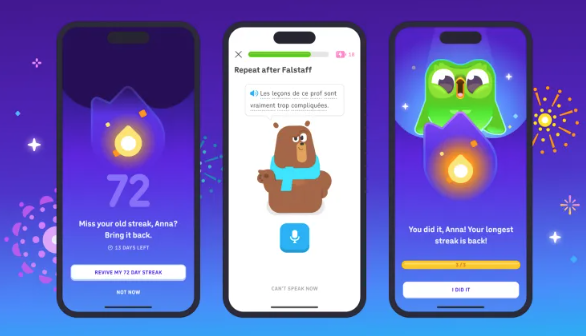
- Duolingo began integrating marketing more directly with its product. Rather than relying solely on funny videos to remind users about the app, it is creating in-app experiences that encourage users to return and share their experiences with others.
The Table below shows a bit of before and after.
Note that ChatGPT was used to do research for this blog post and to generate a first draft of the case teaching note.
How Duolingo’s promotion mix has changed
| Promotion category | Earlier approach | Current approach (2026) |
| Owned media | App notifications, emails, blog, branded social accounts | More emphasis on product engagement, learning streaks, blogs, Reddit participation, and WhatsApp communities |
| Earned media | Outrageous stunts designed to attract press coverage | Still pursuing media attention, but also emphasizing product improvements and company news |
| Social media | Highly centralized around Duo’s outrageous TikTok personality | More balanced humor, supported by hundreds of creators and influencers |
| Paid media | Relatively limited use of traditional advertising | Expanded performance advertising and paid creator partnerships |
| Word of mouth | Fans sharing jokes, memes, and Duo videos | Creator-generated content, in-app experiences, user recommendations, and social sharing |
What do the latest numbers tell us?
Promotional activity remains substantial (see Duolingo shareholder letter, Q2 2026):
- 1 billion+ organic social impressions each quarter from its own accounts,
- 58.7 million daily active users in Q2, 2026, up 23% year over year,
- 12.7 million paid subscribers, up 17% year over year
- $40 million in Q2 sales and advertising spend, up 35% year over year.
- Duolingo now works with hundreds of creators worldwide,
- In China, Indonesia, and India, about two-thirds of social impressions come from influencer-generated content,
- 300% – the growth in the number of channels Duolingo uses in paid media.
How can this information be used in class?
I can see two ways you might use this information in class—at least until I update the print text in a couple of years.
First, you could just add this to your lecture on Chapter 16. Note that Duolingo continues to use paid, earned, owned, and social media extensively in its marketing strategy. And it continues to work—though just in a different way that previously.
Second, you could make sure students read the Chapter 16 case-opener on Duolingo. Then you can provide them with the “AI-first” update and subsequent fallout. From there, use this as a real-world case study. The next section outlines how that could work.
You can also assign, or discuss, one of Duolingo’s plans as described in “Duo the owl’s next big act is an animated series,” Fast Company, October 12, 2026. See DuoTV on YouTube and perhaps show an episode or two (they are less than two minutes each).
Case Study: Duolingo, the “AI-first” statement and blowback. What next?
Download a teaching note for this case study here: