
#AI4M: Who Needs Focus Groups? AI Startups Are Replacing Human Respondents
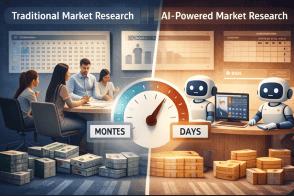
The market research industry — a roughly $150 billion sector long built on surveys, focus groups, and human panels — is facing a wave of AI-driven disruption. Two recent articles shine a light on startups racing to replace human respondents with AI-generated agents that simulate how real people think and behave. The Wall Street Journal article “Can AI Replace Humans for Market Research?” (March 6, 2026) profiles Simile, a Stanford spinout that has raised $100 million in Series A funding to build what it calls “agentic twins” — AI agents trained on real people’s preferences, personality traits, and purchase behavior. CVS Health and Gallup are among Simile’s early customers. CVS’s digital twin roster is built on nearly 2.9 million responses from over 400,000 consenting individuals, and internal testing found that the AI agents replicated known research findings with up to 95% accuracy. Gallup, for its part, plans to deploy over a thousand digital twins to support policy research, trend analysis, and corporate studies.
Sitting alongside Simile in this emerging space is Aaru, the subject of a second Wall Street Journal profile, “Aaru, the Billion-Dollar AI Startup Founded by Teenagers” (March 11, 2026). Aaru was co-founded by Cameron Fink and Ned Koh when they were 18 and 19 years old, respectively, alongside technology chief John Kessler, who was just 15 at the time. Despite their youth, the company recently reached a $1 billion valuation. Aaru’s approach is similar in spirit to Simile’s but leans heavily on demographic and psychographic profiling to generate AI bots that match specific client target segments. The company has done research work for McDonald’s, Boston Beer, Bayer, and film studio A24. In one striking example, Aaru replicated a 500-person, two-month consumer research project for Spindrift Beverage in a single week — and matched the results.
Both companies point toward the same core value proposition: speed, cost savings, and the ability to ask unlimited follow-up questions without respondent fatigue. Where a traditional research study might take months and cost millions, these AI platforms can turn around insights in days for a fraction of the price. That said, both articles are careful to note the limitations. Simile’s CVS partners backtest AI results against real human responses and stress that they will never stop talking to actual customers. An analyst at Gartner notes it is still early days, and that AI agents are better suited to relatively low-stakes research tasks than to high-consequence decisions. The honest takeaway is that AI market research is not yet a full replacement for the human element — but it is changing the economics and speed of the industry in ways that marketing managers need to understand.
Relevant Chapters in Essentials of Marketing
These two articles are a natural fit for Chapter 7 (Improving Decisions with Marketing Information), which covers the five-step marketing research process, the role of data in reducing uncertainty, and the rapidly changing tools available to marketing information systems — including big data and AI. The articles also connect well to Chapter 3 (Evaluating Opportunities in the Changing Market Environment), specifically the Technological Environment section, as AI-powered simulation represents a disruptive force reshaping an entire industry. For instructors covering Chapter 9 (Product Management and New-Product Development), both Simile and Aaru are being used by clients to test product concepts and accelerate the innovation cycle — Spindrift’s iced tea line being a vivid example. Finally, Chapter 4 (Focusing Marketing Strategy with Segmentation and Positioning) is relevant because Aaru’s bots are built using demographic and psychographic dimensions to mirror specific target segments, mirroring exactly how the textbook describes the segmentation process.
Class Discussion Ideas
These articles work especially well in Chapter 7, but instructors will find that the topic naturally spills into adjacent chapters on consumer behavior, segmentation, and the marketing environment. The comparative angle — two startups, different founders, similar missions — gives students an opportunity to evaluate not just the technology but the business strategy behind it. Consider assigning one or both articles before class, or using the summaries above as a brief lecture launch pad.
In-Class Activities
- Research Method Debate. Divide the class into two teams — one assigned to defend traditional human-based market research, the other to argue for AI-simulated research. After brief preparation time, run a structured debate and follow with a class vote and debrief on what each method actually does well. (Chapter 7)
- Design a Digital Twin. Ask students to outline how they would build an AI agent that represents a specific consumer segment of their choosing (e.g., Gen Z sneaker enthusiasts, suburban parents purchasing minivans). What data would they gather? What questions would they ask? How would they validate accuracy? Groups share their designs and the class discusses where the approach might succeed or fail. (Chapters 4 and 7)
- Innovation Speed Test. Present the Spindrift case as a mini case: a new product team has $50,000 and a two-month deadline. Should they commission 500 human respondents or use an AI research platform? Students work in groups to outline the factors they would weigh and present their recommendation. (Chapters 7 and 9)
Discussion Questions with Suggested Answers
- How do AI-simulated research platforms like Simile and Aaru fit into the five-step marketing research process described in the textbook? (Chapter 7)
- Answer: AI-simulated platforms most directly affect Steps 3 and 4 — getting problem-specific data and interpreting it. Instead of recruiting human panels and administering surveys (Step 3), companies can query AI agents and receive responses almost instantly. In Step 4, the platforms offer the ability to probe more deeply with unlimited follow-up questions, something traditional research rarely affords. However, Steps 1 and 2 — defining the problem and analyzing the situation — still require human judgment, and Step 5 (solving the problem) requires managers who can critically evaluate whether AI-generated insights are trustworthy enough to act on.
- In what ways does this technology represent a disruption of the technological environment? What other industries might face similar disruption? (Chapter 3)
- Answer: Chapter 3 describes the technological environment as a force that creates new opportunities and renders established methods obsolete. AI-simulated research threatens to commoditize what was once a high-margin, labor-intensive consulting service. Industries that similarly rely on human panels, surveys, or large-scale data collection — clinical research, political polling, brand tracking — are all candidates for similar disruption. Instructors might encourage students to think about which parts of a business process are genuinely irreplaceable by AI and which are simply expensive because no cheaper alternative previously existed.
- Both Simile and Aaru use demographic and psychographic data to build their AI agents. How does this connect to the segmentation concepts covered in the textbook? (Chapter 4)
- Answer: Chapter 4 explains that marketers use dimensions like demographics, psychographics, and behavioral traits to define and reach target markets. AI research platforms operationalize exactly these dimensions to construct digital twins that are meant to mirror specific segments. The Aaru example with Spindrift is particularly instructive: Aaru modeled bots after consumers aged 25 to 35 with household incomes above $100,000 — a clearly defined target segment. Students should recognize that the quality of the segmentation inputs determines the quality of the AI output, linking segmentation strategy directly to research validity.
- What are the key limitations of AI-generated market research, and how might those limitations affect a marketing manager’s confidence in the results? (Chapter 7)
- Answer: Chapter 7 emphasizes the importance of validity and reliability in marketing research. AI simulations can replicate patterns from past behavior but may struggle to capture genuine novelty — a truly new product concept or an emotionally charged situation without precedent in the training data. Aaru’s failure to predict the 2024 presidential election outcome is a reminder that AI models are fallible. Marketing managers would be wise to treat AI research as a complement to, rather than a full replacement for, human data collection, especially for high-stakes decisions or when studying behaviors that are rapidly evolving.
- How might AI-simulated market research accelerate the new-product development process? What are the risks of moving too fast? (Chapters 7 and 9)
- Answer: Chapter 9 describes new-product development as a staged process that includes concept testing and market testing. AI research can dramatically compress the time required for concept evaluation — as the Spindrift example shows, weeks instead of months. This speed advantage is real and meaningful, particularly in fast-moving consumer goods categories. The risk is that speed can breed overconfidence: a result that looks valid in simulation may not hold when real consumers encounter a product in the real world, with all the friction, emotion, and social context that entails. Managers should use AI research to narrow the field of options quickly, but not skip the step of testing with actual customers before committing to a full launch.
- CVS says it will “never stop talking to real customers” even as it expands its use of AI twins. Do you think that is a genuine commitment or simply good public relations? Defend your answer. (Chapters 7 and 19)
- Answer: This question invites students to evaluate a company’s stated values against its likely economic incentives. The honest answer is probably both — it is genuinely good practice (AI systems need human validation to stay calibrated), and it is also smart messaging in a world where consumers are increasingly sensitive to feeling surveilled or replaced by machines. Chapter 19’s discussion of the macro-marketing implications of marketing practices is relevant here: companies that build research pipelines entirely on synthetic data risk losing touch with the genuine, lived experience of their customers, which can lead to costly blind spots. Instructors can use this to open a broader conversation about the limits of efficiency as a sole guide for marketing decisions.
- Should marketing managers view AI-simulated research as an ethical way to gather consumer insights, or does it raise concerns about privacy, consent, and representation? (Chapters 1 and 3)
- Answer: Chapter 1 introduces the idea that marketing has social responsibilities, and Chapter 3 covers the legal and cultural environment in which firms operate. Both are relevant here. Simile notes that its agents are built from consenting participants’ data, which addresses one ethical concern, but students should think about what “consent” means when individuals may not fully understand how their data will be used or how realistic and long-lived their digital twin will be. Representation is another issue: if the training data skews toward certain demographics, the AI twins will too, potentially introducing systematic bias into research findings. This is a rich area for debate, and instructors may want to connect it to broader discussions happening in AI ethics and data governance.
The chatbot Claude generated a first draft of this blog post. The images were generated by ChatGPT.