
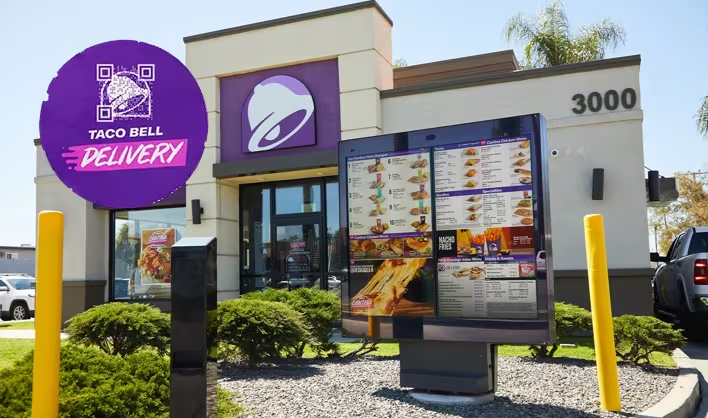
#AI4M: Taco Bell Has AI in 890 Drive-Thrus. Most Customers Don’t Notice.
Kristen Charpentier’s first clue was that the voice was too nice. She pulled into a Dairy Queen drive-thru in Cary, North Carolina, and the speaker greeted her with pleases and thank-yous and a perfectly polite pitch for extra Snickers on her Blizzard. “There was no communication delay or weirdness to it. It felt completely natural,” she told WIRED. “But just a little too pleasant to be human.” Charpentier had worked that same drive-thru window as a teenager. She knew. Kate Taylor tells the story in “AI Conquered Coding. Fast Food Is Next” (WIRED, August 3, 2026).
The numbers are still small, but they are moving. Intouch Insight’s annual Drive Thru Survey put voice AI in roughly 4 percent of U.S. fast-food locations in 2024 and 5 percent last year; early research puts it near 6 percent now. Taco Bell announced in July that it runs AI in 890 drive-thru lanes, more than 10 percent of its U.S. stores. Twelve percent of White Castles use an AI named “Julia,” and every new location opens with her. This is the second attempt. The first one failed in public — a viral TikTok of McDonald’s AI stacking 260 Chicken McNuggets onto an order while the customers screamed “Stop!”, bacon added to an ice cream, a guy who ordered 18,000 cups of water at Taco Bell. Del Taco pulled its test in 2024. McDonald’s sold its AI division to IBM and shut the effort down.
Round two is going better, and the results are mixed in a more interesting way. Intouch finds AI lanes beat the industry average by 21 seconds, but its surveys also found them less friendly than humans and less accurate on orders. AI agents attempt an upsell 71 percent of the time against an industry average of 58 percent. Reported customer satisfaction is 97 percent. Some chains are staying out on purpose: Chick-fil-A, Dutch Bros, and 7Brew have all passed. “For us, hospitality starts with genuine human connection,” 7Brew chief marketing officer Nick Chavez told WIRED. Charpentier sees it differently. “There is more consistency with AI than there is in humans.”
Claude was used to write a first draft of this blog post.
Relevant Chapters in Essentials of Marketing
Chapter 9 (product management and total quality management) fits because the chapter discusses building quality into services, Chapter 9 states that a service provider deals directly with the customer, which makes consistent quality hard, and that “people are not as consistent in their actions as machines or computers.” That is a customer’s closing argument in the article and a textbook sentence at the same time.
Ultimately, fast food is a retail operation, so Chapter 12 (retailers, wholesalers, and their strategy planning) also fits. Exhibit 12–5 classifies retailers partly by the level of service they offer, and the chapter treats that level as a strategy decision rather than a default. Chapter 12 makes the split in this article explicit: some retailers use AI and automation to speed up shopping, while others invite customers to slow down and treat the store as an experience.
Chapter 8 (elements of product planning for goods and services) is another potential link. Exhibit 8–3 uses a restaurant meal as its example of a blend — food as the physical good, the staff’s preparation and service as the service half. Exhibit 8–4 then lists the differences that matter here: services are produced locally in front of the customer, which is exactly what makes economies of scale hard for a service firm. Voice AI is an attempt to pull one slice of a locally produced service back into something centrally built and controlled, the way a factory controls a good. Chapter 14 is worth a mention too, since it describes retail salesclerks as order takers who frequently spot opportunities to generate additional sales — which is precisely the job the AI is doing 71 percent of the time.
Class Discussion Ideas
The useful classroom angle here is that the article hands students a live disagreement about a claim their textbook already makes. If machines really are more consistent than people, and consistency is a quality problem, why are three of the fastest-growing chains in the country refusing the technology? The activities below push students to separate the part of a service that can be standardized from the part that is the service, and then to defend a service-level decision as a strategy choice rather than a technology choice.
In-Class Activities
- Touchpoint Map. In small groups, have students map every touchpoint in a single drive-thru visit, from the moment the car turns into the lot to the first bite in the parking space, following the Jiffy Lube example in Chapter 9. Then have them mark which touchpoints voice AI touches and which it cannot. Groups post their maps and the class argues about where quality is actually won or lost. (Chapter 9)
- The 7Brew Pitch. Role-play. Half the teams are consultants pitching voice AI to 7Brew’s leadership; the other half prepare the response defending the company’s decision to stay out, starting from Nick Chavez’s quote. Each side must name the target market it is serving and what the choice does to the rest of the marketing mix. Five minutes per side, then a class vote on which case held up. (Chapter 12)
- Service Level Sort. Individually, students place six chains — Chick-fil-A, Taco Bell, White Castle, Dutch Bros, McDonald’s, and Wendy’s — along the service dimension in Exhibit 12–5, then write one sentence per chain explaining whether its AI decision fits where they placed it. Collect the outliers and discuss the ones the class disagreed about. (Chapter 12)
- Upsell Script Test. In teams, students write two 30-second drive-thru scripts for the same order, one for a human order taker and one for a voice AI, each attempting a single upsell. Two volunteers perform both versions for the class. Debrief on whether the machine’s pitch reads as service or as pressure, and on what the 71 percent figure would feel like on a customer’s fourth visit that week. (Chapter 14)
Discussion Questions (and Answer Ideas)
- Where does a fast-food meal sit on the goods-services continuum, and why does that placement matter for the drive-thru AI decision? (Chapter 8)
- Answer. Exhibit 8–3 places a restaurant meal in the middle of the continuum: a physical good prepared and served by staff. The food can be standardized the way a factory standardizes a good, but Chapter 8 notes that services are produced locally, in front of the customer, which is what makes them hard to standardize. Voice AI is an attempt to move one slice of the service half toward the goods half. Students should notice how narrow that slice is — the food is still made and handed over by a person.
- Chapter 9 says “people are not as consistent in their actions as machines or computers.” Kristen Charpentier makes the same argument at the end of the article. Does consistency by itself produce service quality? (Chapter 9)
- Answer. No. Chapter 9’s two keys to service quality are training and empowerment, and empowerment means the authority to fix a customer’s problem without checking with a manager. An AI order taker is consistent and has no authority to make anything right, which is why chains keep a human on a headset to intervene. Strong answers will separate the two: consistency prevents the worst experience without producing the best one. Some students will push back that for a $4 Blizzard, avoiding the worst experience is the whole job — that is a defensible position and worth hearing.
- Intouch Insight found AI drive-thrus were less friendly and less accurate than humans, and also reported 97 percent customer satisfaction. How can both be true? (Chapter 9)
- Answer. Chapter 9 argues quality is judged across the entire customer experience, with every touchpoint contributing. Speed is one touchpoint the AI wins outright, by 21 seconds, and speed may simply matter more in this category than friendliness does. Students should also ask what the 97 percent measures and who was asked; a survey of completed orders will not count anyone who drove off. The number also comes from a firm that sells drive-thru research.
- Chick-fil-A tops the friendliness rankings, has famously long lines, and has never hinted at AI ordering. Is that a mistake? (Chapter 12)
- Answer. Open-ended by design. Chapter 12 treats service level as a strategic choice, and it explicitly contrasts retailers that use automation to speed things up with retailers that invite customers to slow down. Chick-fil-A’s lines suggest that speed is not what limits its business and that friendliness is its point of difference. Students may reasonably argue the reverse: 21 seconds per car, multiplied across the longest lines in the industry, is exactly where automation would pay off most. Push them to say which target market their answer serves.
- AI agents attempt an upsell 71 percent of the time, against an industry average of 58 percent. Who is that better marketing for? (Chapter 14)
- Answer. Chapter 14 describes retail salesclerks as order takers and notes that order takers often spot chances to generate additional sales, so the AI is doing the job as the chapter defines it. The harder question is whether an upsell attempted nearly every time is still customer service. Chapter 14 also warns that customers will take their business elsewhere rather than deal with a clerk who annoys them. Students should weigh the margin gain against what happens when the pitch stops feeling like a suggestion.
- The article imagines a drive-thru that recognizes your car and offers a milkshake deal because it calculates you are 78 percent more likely to buy dessert on the second Tuesday of the month. White Castle’s Jamie Richardson says, “We never want to seem creepy.” Where is that line, and how would a marketer know they had crossed it? (Chapter 12)
- Answer. Chapter 12 covers AI-powered personalization among its trends in online retail and raises the ethical questions the technology creates for retailers. The line usually sits at whether the customer understands why the offer arrived and gets something out of it. Ask students to name one personalized offer they welcomed and one that unsettled them, then find the difference between them. A good follow-up: should a restaurant be required to tell you that the voice is a machine?