
Play-Doh Grows Up (Again) — A Segmentation Case Study
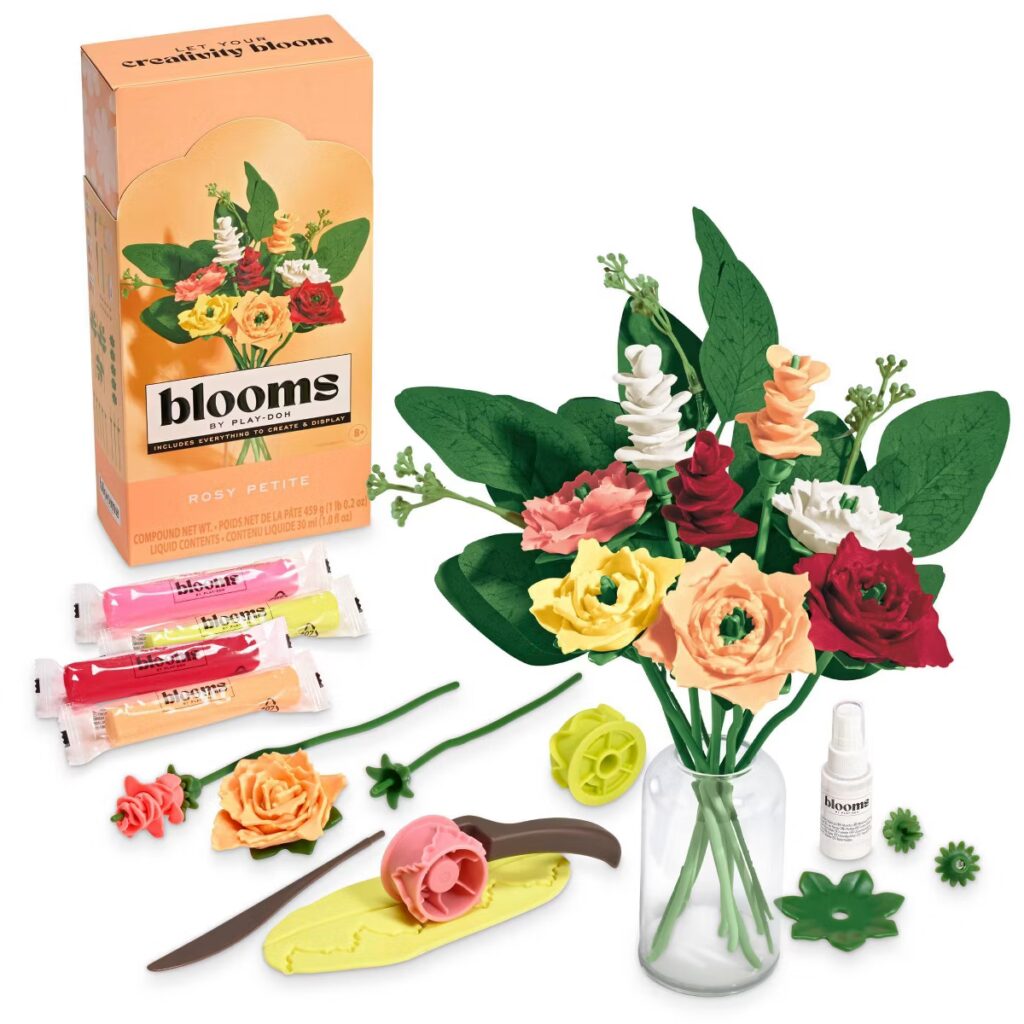
Hasbro is taking another run at adult Play-Doh, and this time it’s betting on flowers instead of lattes (see “Hasbro’s ‘Aging Up’ Strategy Continues With a Reattempt at Adult Play-Doh,” The Wall Street Journal, July 9, 2026). Blooms by Play-Doh, launched this month, walks adult buyers through turning modeling compound into floral arrangements meant to sit on a shelf, not get flattened by a toddler. It’s the newest move in Hasbro’s “aging up” strategy, launched last year to counter a multiyear sales slide once the pandemic-era toy boom faded. Hasbro also owns Nerf and Peppa Pig, and its most recent quarter posted a 13% revenue jump to $1 billion — but that gain came almost entirely from Magic: The Gathering. Consumer products, the segment Blooms sits in, were flat.
This isn’t Play-Doh’s first swing at grown-ups, and that history is what makes the case interesting. In 2020, Hasbro launched Grown-Up Scents — tubs of Play-Doh scented like “overpriced latte” and “mom jeans” — followed by a ’90s edition with scents like “mall food court.” It flopped. Hasbro CMO Jason Bunge says the products still looked and felt like kids’ Play-Doh, just repackaged, and adult customers couldn’t shake the association. Lego, by contrast, solved this years ago with sophisticated sub-brands and display-worthy sets that let adult buyers feel like they’d graduated, not regressed.
Blooms tries to fix that with a new brand name, a display-first product, and a promotion plan built almost entirely around creators instead of ads. Hasbro has enlisted more than 200 influencers, planned a full-day creator event in Brooklyn, and arranged a hands-on session at the Whitney Museum of American Art. “Paid media, it doesn’t work for us anymore,” Bunge told the Wall Street Journal, noting Hasbro recently pulled its media buying in-house. Whether Blooms can move the needle on Hasbro’s flat consumer-products line is the real test of whether the aging-up strategy is working — or whether Play-Doh just has a harder time shedding its kid-brand image than Lego did.
Claude was used to generate a first draft of this blog post.
Relevant Chapters in Essentials of Marketing
Blooms is a clean segmentation case, which is why it pairs well with our Lego opener in Chapter 4 (market segmentation, target marketing, differentiation and positioning). Hasbro is targeting a psychographic segment — screen-weary adults drawn to calming, hands-on hobbies and “more feminine tastes,” in Bunge’s words — rather than an age bracket, and the article makes an explicit positioning comparison: Lego convinced adults they could keep playing, while Play-Doh’s 2020 attempt failed because it repackaged the same product instead of repositioning it. Chapter 8 (branding, brand familiarity, product classes) is the second anchor. Blooms is a new endorsed brand — “Blooms by Play-Doh,” not a straight Play-Doh line extension — which is exactly the branding decision Chapter 8 covers: Hasbro is betting that a distinct brand identity, not just new scents or colors, is what separates a successful adult product from a failed one. Chapter 16 is also relevant as the article notes that it is relying on influencers and earned media to generate awareness and trial.
Class Discussion Ideas
The most useful classroom angle here is comparative: once you change the target market, what has to change about the rest of the marketing mix? The activities and questions below build on that shift, and on why the 2020 attempt failed when this one might not.
In-Class Activities
- 4Ps Redesign. In teams, have students take a standard Play-Doh product and redesign the full marketing mix — product, price, place, promotion — for the Blooms adult target versus the traditional kids’ target. Have each team present a side-by-side comparison to the class. (Chapter 4)
- Positioning Map. Students plot traditional Play-Doh, Blooms, and Lego’s adult sets on a positioning map using two dimensions of their choosing — price and “display-worthiness” work well. Discuss what the map reveals about the gap Hasbro is trying to fill. (Chapter 4)
- Branding Autopsy. Split the class into groups to diagnose why Grown-Up Scents failed using brand familiarity concepts, then have each group pitch one branding fix Hasbro should have made in 2020. Good for short group presentations. (Chapter 8)
- Creator Casting. Ask students to identify three types of creators — by niche, platform, and audience — Hasbro should recruit for Blooms, and to justify each pick using the segment description in the article. (Chapter 4)
Discussion Questions
- What need state is Hasbro trying to meet with Blooms, and how does it differ from the need Play-Doh meets for children? (Chapter 4)
- Answer: For kids, Play-Doh serves imaginative, hands-on play. For Blooms’s adult target, the need is stress relief and a screen-free outlet that produces something worth keeping. Same base material, entirely different need state — which is why the marketing mix has to change, not just the label.
- Bunge says Hasbro is “not manufacturing a new need state,” just meeting one that already exists. Do you agree, based on what’s in the article? (Chapter 4)
- Answer: Students should weigh the evidence on both sides. The broader boom in adult hobbies like pottery and flower arranging suggests real, pre-existing demand. But Hasbro has an obvious incentive to say the demand was already there, and the 2020 attempt presumably targeted a real need too — its failure suggests execution and branding, not demand, may be the harder problem to solve.
- Why did Grown-Up Scents fail while Lego’s adult strategy succeeded? (Chapter 8)
- Answer: Grown-Up Scents kept the same tubs and the same core product, and just changed the scent and label — brand familiarity worked against Hasbro because customers still saw “Play-Doh” and defaulted to the kids’ association. Lego built distinct sub-brands and display-worthy sets that looked and functioned differently enough to earn a separate identity in customers’ minds.
- Compare the branding decision behind Blooms — a new name with “by Play-Doh” attached — to the straight line-extension approach of Grown-Up Scents. What’s different, and why might it matter? (Chapter 8)
- Answer: Blooms uses an endorsed-brand structure: a new name carries the product, while “by Play-Doh” lends raw-material credibility in smaller type. Grown-Up Scents put the full weight of the Play-Doh name and tub design on the product. The endorsed structure gives Blooms room to build its own identity instead of fighting the kid-brand association head-on.
- Play-Doh is sold mostly in the toy aisle. If Hasbro is serious about this new target market, how might Place decisions need to change for Blooms? (Chapter 4)
- Answer: Less than students might expect: Blooms launched at Amazon, Target, and Walmart — the same mass retailers that sell traditional Play-Doh, just without a single retailer carrying the full six-kit lineup yet. The real Place shift is digital — Blooms marked Play-Doh’s first appearance on TikTok Shop, putting the product directly in front of the creator audience the promotion strategy is built around. Worth discussing: is skipping a dedicated craft-retail presence (a Michaels, for instance) a missed opportunity or a smart bet that the audience is online, not in stores?
- The article says Hasbro has largely dropped paid media in favor of creators, algorithmic ads, and earned press. How does this promotion mix differ from a traditional toy launch, and why might it fit this audience better? (Chapter 16)
- Answer: A traditional toy launch leans on paid advertising aimed at parents. Blooms leans on earned and owned media — 200-plus creators, a museum activation, press coverage — aimed at adults who are more likely to trust a recommendation from a niche creator than a toy commercial. The medium is matched to an audience that doesn’t see itself as a toy-commercial audience at all.
- A kit that produces a finished, displayable arrangement is a different product than a tub of loose compound. What does that format suggest about how Hasbro might price Blooms relative to traditional Play-Doh? (Chapter 4)
- Answer: It supports premium pricing, and the numbers back it up: Blooms kits run $24.99 to $40, versus a couple of dollars for a standard Play-Doh tub. A kit sells a finished experience and a keepable result — compound, tools, molds, a vase, and finishing spray — not raw material, and the price reflects that shift in what’s actually being sold.
- Evaluate the risk in Blooms’s launch. What could cause it to fail the way Grown-Up Scents did? (Chapters 4 and 8)
- Answer: Possible risks: the Play-Doh name still triggers kids’ associations despite the rebrand, the launch relies too heavily on influencer buzz that fades once the creator event ends, or the product turns out to be a one-time novelty purchase rather than a repeat one. Strong answers will tie the risk back to specific evidence in the article rather than speculate in the abstract.